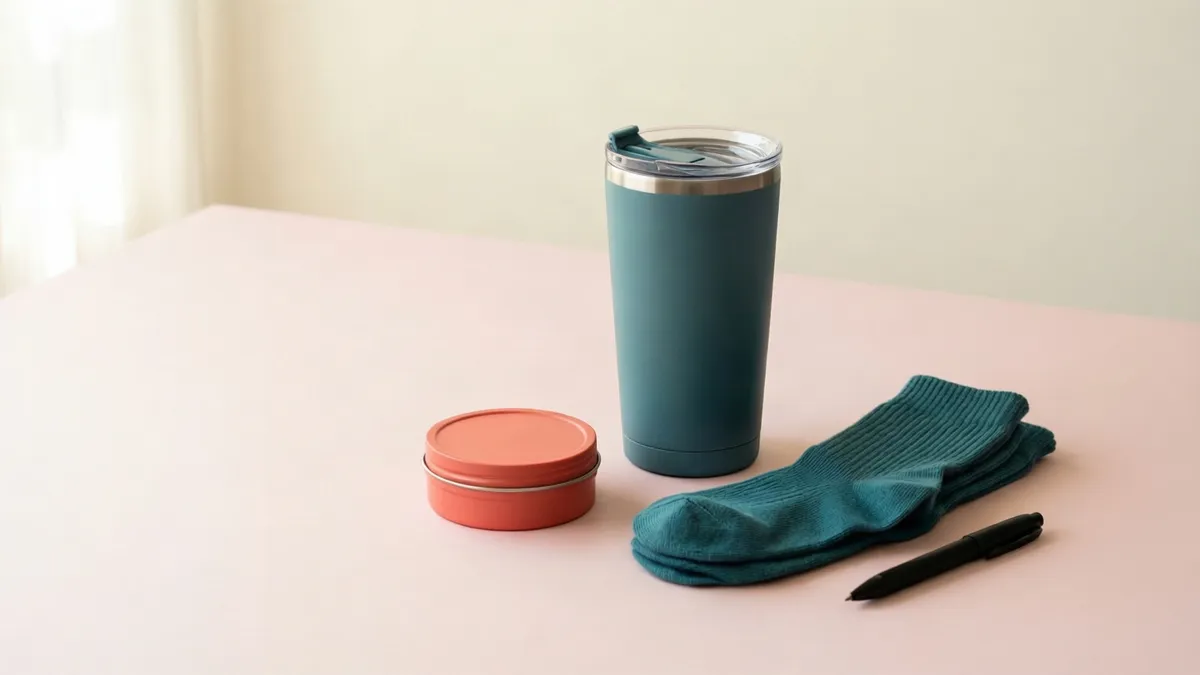
In short: Judge a nurse gift by the shift, not by the profession. If it does not fit in a scrub pocket or a locker, survive being wiped down, and get used standing up in a twenty-minute break, it is decoration. For the most common buyer — a patient's family after a hospital stay — the answer is almost always food or drink for the whole unit. Add a written note naming the people who helped, and check at the desk first.
We write buying guides, not lab reviews: nothing on this page has been tested on a hospital floor by us. Prices, availability and ratings change constantly — whatever Amazon shows when you click is the authoritative figure.
Search this category and you get badge reels, mugs and "nurse life" apparel. Some of it is fine. Most of it is bought because the buyer knows one thing about the job and nothing else.
This guide starts somewhere else. It starts with the working day, then with your occasion, then with the hospital's rules — which almost nobody mentions and which can decide the whole question for you.
The shift test
Four questions. Run every idea through them before you buy.
- Does it fit? A scrub pocket or a locker is the whole storage system. Anything larger goes home in a car, and often stays there.
- Does it survive? It will be wiped down, dropped, and left somewhere warm. Fragile, fabric-covered or battery-dependent things do badly.
- Can it be used in twenty minutes, standing up? Break time is short and interrupted. A gift that needs an evening is a gift for a day off, not for work.
- Does it need a size, a color or a preference you cannot know? If yes, you are guessing, and the recipient has to be gracious about your guess.
One popular framing does not survive scrutiny, so we will not use it. You will read everywhere that nurses walk four or five miles a shift and stand all day. The U.S. Department of Labor's O*NET work-context data for registered nurses, updated 2026, points the other way: 54% of respondents said they spend time standing "less than half the time," and only 25% said continually.
That is not an argument that the job is easy. The same page reports 61% exposed to disease or infections every day. It is an argument for buying against the real constraints — pockets, lockers, short breaks — instead of against a statistic nobody can source.
Start with the occasion
Five buyers turn up in this category, and they have five different problems. Find yours.
A patient or a patient's family after a stay. You want to thank a team, not a person, and you may not remember every name. Care that gets shared beats care that gets kept. Category: food or drink for the break room, plus a written note.
A parent or partner at a graduation or pinning. The recipient is about to start a job with a locker and a commute, and owns almost nothing for it yet. Category: something durable and personal for the first year, not clinical equipment.
A manager stocking a break room for Nurses Week. The American Nurses Association (ANA) sets National Nurses Week as May 6–12; its board designated those permanent dates beginning in 1994, and May 12 is Florence Nightingale's birthday. The ANA's 2026 theme was "The Power of Nurses." Category: a per-head item that works on every shift, including nights.
A coworker at Christmas or a retirement. You know this person's actual taste, which is a real advantage. Category: the specific thing they have mentioned, or a consumable in their exact flavor.
A new parent thanking the labor and delivery team. Shifts changed while you were there, so the team is bigger than the faces you remember. Category: something for the unit that keeps for a few days.
What nurses say they do not want
The loudest complaint in this category is nurse-themed merchandise, and it is worth taking seriously. A badge reel with a joke on it, a mug about coffee dependence, a tote bag with a stethoscope printed on it: the recipient already owns three.
We have no survey to put behind that, and we are not going to invent one. What we can point to is a related argument in the profession's own press. Writing in Colorado Nurse in August 2026, nurse practitioner Lauren M. Koziel argued that "tokenistic gestures such as food-based rewards or generic appreciation events are often perceived as superficial and disconnected from real workplace challenges."
That is one author's position in a nursing publication, not research. But it names the failure mode precisely. A gift reads as tokenistic when the effort went into the theme rather than into the person.
There is also an age assumption baked into a lot of this merchandise. The National Council of State Boards of Nursing's 2024 National Nursing Workforce Survey, published in 2025, put the median age of registered nurses at 50. Novelty aimed at a twenty-two-year-old will miss more often than it lands.
Categories that pass the test
This article contains affiliate links. If you buy through one, we earn a small commission at no extra cost to you. We only recommend what we would suggest to a friend. The Federal Trade Commission's endorsement guides, 16 CFR Part 255, require a material connection like ours to be disclosed clearly and conspicuously, which is what that sentence is doing.
Food and drink for the break room. (The categories we point to are collected on one page.) The single most reliable answer, because it needs no size and no preference, and it gets shared across a shift. Sealed and individually wrapped beats a shared platter, and it survives a shift change. Label anything with nuts.
A good pen. Pens vanish constantly and get replaced with whatever is on the counter. A solid metal one that clips into a pocket is small, cheap and used constantly. It also passes every question in the shift test.
A badge reel that is not a joke. Plain, sturdy, retractable, in a color rather than a slogan. The failure here is not the object, it is the novelty printed on it.
An insulated bottle or tumbler. Genuinely used, genuinely replaced often. One caution: check the recall list before you buy any lid-and-seal product. The U.S. Consumer Product Safety Commission's record for the Stanley Switchback and Trigger Action travel mugs, dated December 12, 2024, covers 2.6 million units whose lids could detach during use.
See insulated tumblers on Amazon.
Coffee and tea. A bag of whole beans from a named roaster, or a box of a specific tea, beats anything with a caffeine joke on it. This works as a personal gift and as a break-room gift, in different sizes.
Compare coffee gift sets on Amazon.
One thing for the drive home. A car phone mount, a small tidy for the console, a set of good sunglasses. The commute is part of the day, and almost nobody buys for it.
A gift card, when the workplace allows it. More on the "when" below, because it matters more than the amount. Gift cards are a mainstream US gifting choice: the National Retail Federation reported in April 2026 that 55% of Mother's Day shoppers planned to buy one, from a survey of 7,877 US adults. That is Mother's Day data, not nurse data, and many hospitals prohibit gift cards for staff outright.
Things that touch the body
This is a gifting guide, not medical advice. Nobody on this site is a clinician, and anything worn or used for a health reason is a question for the person's own healthcare provider.
With that said, three categories come up constantly, and the honest framing is the same for all three.
Compression socks. Many nurses buy them, and people who wear them usually have a brand, a compression level and a fit they already prefer. We are not going to tell you what they do, because that is not our field. Treat them as a preference item you probably cannot guess, and ask before buying.
Hand and skin care. Hands get washed and sanitized constantly at work, and a lot of nurses keep a cream in a pocket for that reason. Buy fragrance-free unless you know their preference, and buy a tube small enough to carry.
Look at fragrance-free hand cream on Amazon.
Shoes and insoles. Skip them. They are sized, they are intensely personal, and the choice is often tied to something the person's own provider has said. A gift card to a shoe retailer is the version of this gift that works.
Buying for a whole unit
Team gifting is a different exercise from choosing one gift, and it fails in predictable ways.
Work out the per-head number first. A unit is a dozen people or more, spread across several shifts. Divide the budget before you shop, not after. A small item that everyone gets beats a nice item that four people get.
You are also buying for a bigger group than the one you met. Hospitals were the primary employment setting for 53% of registered nurses in the National Council of State Boards of Nursing's 2024 survey. The American Association of Colleges of Nursing put the registered nurse workforce at 3.39 million in 2024.
Assume dietary restrictions. Nuts, gluten, dairy, and people who do not eat sugar. A mixed box with labels solves this. One homemade tray does not, and some units cannot accept homemade food at all.
Do not let night shift get the leftovers. This is the most common complaint about break-room gifting, and it is easy to fix. Either send a second box marked for nights, or drop it near the end of a day shift so nights get an untouched one.
Night shift is also the part of the schedule that occupational-safety research treats as genuinely hard. The Occupational Safety and Health Administration reports accident and injury rates 30% greater during night shifts than day shifts, citing Smith et al., 2011. That is research about schedules, not about products. Nothing you can buy changes it, and anyone who tells you otherwise is selling something.
A card everybody signs is not the consolation prize. Written thanks that names people is the one gift with no policy problem, no size, no allergy and no shelf life. If the budget is tiny, put it here.
If you are mailing it
Two rules from the United States Postal Service catch people out. Under Publication 52 §424, intoxicating liquors are nonmailable, so a bottle of wine to a hospital address is not an option through the mail. Under §53, fresh fruits and vegetables are nonmailable unless presented in a dry condition, and other perishables that spoil in transit are nonmailable too.
Shelf-stable, sealed and boxed is the format that arrives. A local bakery or grocery delivery avoids the question entirely.
The policy question
Here is the part every other gift guide leaves out.
Hospitals set their own rules about what staff may accept, and some cap the value or ban cash entirely. Check the unit's policy before buying — it is a five-minute question at the desk.
There is no national rule, and we are not going to pretend otherwise. Two published hospital policies show how far apart they sit. Mount Sinai South Nassau's policy OF-ADM-275 was last reviewed in November 2020. It permits gifts "with a fair market value of less than $50 per item, per individual, not to exceed $100 per year." LMH Health's gifts and gratuities policy, posted in April 2026, names no dollar figure at all and asks only that gifts be "of nominal value."
That is one hospital's number and one hospital's silence. Neither is the rule where you are. Schools work the same way, and the published policies on gifts to teachers disagree with each other just as widely.
One prohibition did hold across both. Mount Sinai South Nassau bans "gifts of cash or cash equivalents, regardless of the dollar amount," listing checks, gift certificates, gift cards and stocks. LMH Health states that employees "may not accept cash or cash-equivalent gift (i.e. gift cards) from patients." If you are giving as a patient or a family member, that is the line to assume until someone tells you otherwise.
Be careful with what circulates online here. A widely repeated line claims the National Council of State Boards of Nursing lists accepting gifts as a professional-boundary warning sign. We read its boundaries brochure, copyright 2024, end to end. The word "gift" does not appear in it. Do not plan around a rule that the cited document does not contain.
If the unit cannot accept gifts, you still have the two best options available. Write to the nurse manager and name the individual nurses and what they did. Then send the same thing to the hospital's patient feedback or experience line. Written praise that names people goes into a file that matters to them professionally, and it costs nothing.
What to skip
| Gift | Why it fails |
|---|---|
| Scrubs | Sized, and most units specify a color or a supplier |
| Stethoscopes | Intensely personal, and most nurses already have the one they chose |
| Shoes and insoles | Sized, personal, and often tied to advice we are not qualified to give |
| Sized clothing of any kind | You are guessing, and they have to be nice about it |
| Anything scented | Break rooms and nurses' stations are shared air |
| Anything that needs charging | One more cable, one more thing to forget |
| Novelty mugs | They own several, and the cupboard is full |
| Cash or a gift card, from a patient | Prohibited under both hospital policies we checked |
| Fresh flowers to a unit | Some units do not allow them, and nobody wants to carry a vase home |
| Homemade food, unless you know the unit | Many units accept only sealed, commercially packaged food |
The pattern is consistent. Anything sized, scented, charged or themed puts the work back on the recipient.
Frequently asked questions
What do nurses want for gifts?
Consumables, small things they can carry, or a choice they make themselves. Food and drink for the break room, a good pen, a plain badge reel and coffee are the reliable answers. The unreliable answer is anything with the profession printed on it.
What do you give a nurse who took care of you?
Food or drink for the whole unit, plus a written note that names the people who helped you. The note is the part they keep. Ask at the desk first, because your gift will be shared across a team and the unit may have rules about food from outside.
How many gifts should you give the labor and delivery team?
Think in units, not in people. Shifts change during a stay, so the team that looked after you is larger than the faces you remember. One shared, sealed box for the station plus a card covers everyone, including the people who came on overnight.
Can nurses accept gifts from patients?
Usually yes for small non-cash items, but the rules are set by each hospital. Both published policies we checked permit modest tokens of appreciation and prohibit cash and gift cards. Mount Sinai South Nassau's 2020 policy names a $50 per item limit; LMH Health names no figure. Ask at the desk.
What should you give for Nurses Week?
Give something every person on every shift gets, within May 6–12, the dates the American Nurses Association sets. Divide the budget per head first. Sealed individual snacks, good coffee for the break room, or a plain useful item in quantity all work; a single nice gift for a twelve-person unit does not.
Is a gift card a good gift for a nurse?
From a coworker, a friend or family, it is one of the best gifts here: portable, unsized, and usable on a night shift when nothing is open. From a patient or a patient's family, assume it is prohibited. Both hospital policies we checked classify gift cards as cash equivalents.
What should you not give a nurse?
Scrubs, shoes, a stethoscope, anything sized, anything scented, anything needing a charger, and anything whose main feature is a joke about the job. Also skip fresh flowers and homemade food for a unit unless you have checked that they are accepted.
Rachel Okafor is a gifting editor and a former hospital gift-shop buyer. She is not a nurse or a clinician. How we work is on the about page, her author page has the rest, and our affiliate disclosure explains how the site is funded. Product ideas mentioned here are collected on our products page.
Sources
- American Nurses Association, "History of National Nurses Week," no publication date shown on page. https://www.nursingworld.org/education-events/national-nurses-week/history/ — retrieved 2026-08-19.
- American Nurses Association, "American Nurses Enterprise Kicks Off National Nurses Week Celebrations," May 6, 2026. https://www.nursingworld.org/news/news-releases/2026-news-releases/american-nurses-enterprise-kicks-off-national-nurses-week-celebrations/ — retrieved 2026-08-19.
- O*NET OnLine, sponsored by the U.S. Department of Labor, Employment and Training Administration, "Registered Nurses — Summary Report (29-1141.00)," page marked updated 2026. https://www.onetonline.org/link/summary/29-1141.00 — retrieved 2026-08-19.
- O*NET OnLine, U.S. Department of Labor, "Registered Nurses — Details Report, Work Context (29-1141.00)," page marked updated 2026. https://www.onetonline.org/link/details/29-1141.00 — retrieved 2026-08-19.
- United States Postal Service, Publication 52 § 424, "Nonmailable Intoxicating Liquors," no date shown on section page. https://pe.usps.com/text/pub52/pub52c4_008.htm — retrieved 2026-08-19.
- United States Postal Service, Publication 52 § 53, "Fresh Foods and Other Perishables," no date shown on section page. https://pe.usps.com/text/pub52/pub52c5_011.htm — retrieved 2026-08-19.
- Federal Trade Commission, "16 CFR Part 255 — Guides Concerning Use of Endorsements and Testimonials in Advertising," CFR source note 88 FR 48102, July 26, 2023; text retrieved from the U.S. Government Publishing Office, 16 CFR Ch. I, 1-1-24 edition. https://www.govinfo.gov/content/pkg/CFR-2024-title16-vol1/pdf/CFR-2024-title16-vol1-part255.pdf — retrieved 2026-08-19.
- U.S. Consumer Product Safety Commission, "Stanley Recalls 2.6 Million Switchback and Trigger Action Travel Mugs Due to Burn Hazard," recall number 25063, recall date December 12, 2024; record retrieved via the CPSC SaferProducts recall web service. https://www.cpsc.gov/Recalls/2025/Stanley-Recalls-2-6-Million-Switchback-and-Trigger-Action-Travel-Mugs-Due-to-Burn-Hazard — retrieved 2026-08-19.
- Occupational Safety and Health Administration, U.S. Department of Labor, "Long Work Hours, Extended or Irregular Shifts, and Worker Fatigue — Hazards," no publication date shown; the night-shift figure is attributed on the page to Smith et al., 2011. https://www.osha.gov/worker-fatigue/hazards — retrieved 2026-08-19.
- Mount Sinai South Nassau, "Acceptance of Gifts from Patients — Policy & Procedure OF-ADM-275," last reviewed November 2020. https://www.southnassau.org/uploads/public/documents/brochures/MSSN%20Acceptance%20of%20Gifts%20from%20Patients%20(27733_0).pdf — retrieved 2026-08-19.
- LMH Health, "Gifts, Gratuities & Business Courtesies Policy," posted April 2026. https://www.lmh.org/wp-content/uploads/2026/04/Gifts-Gratuities-Business-Courtesies-Policy.pdf — retrieved 2026-08-19.
- National Council of State Boards of Nursing, "The 2024 National Nursing Workforce Survey — RN findings," published 2025 in the Journal of Nursing Regulation 16(1), S1–S88. https://www.ncsbn.org/research/recent-research/workforce/2024-workforce-rn.page — retrieved 2026-08-19.
- National Council of State Boards of Nursing, "A Nurse's Guide to Professional Boundaries," copyright 2024, print code 10/24. https://www.ncsbn.org/public-files/ProfessionalBoundaries_Complete.pdf — retrieved 2026-08-19.
- American Association of Colleges of Nursing, "Nursing Shortage Fact Sheet," last updated August 2026. https://www.aacnnursing.org/news-data/fact-sheets/nursing-shortage — retrieved 2026-08-19.
- National Retail Federation, "Mother's Day Spending Expected to Hit Record $38 Billion," April 21, 2026. https://nrf.com/media-center/press-releases/mother-s-day-spending-expected-to-hit-record-38-billion — retrieved 2026-08-19.
- Lauren M. Koziel, APRN, MSN, FNP-C, "Take This Crust and Stuff it: Beyond Pizza Parties, What Nurses Identify as Meaningful Recognition in Contemporary Practice," Colorado Nurse, published on myamericannurse.com, August 17, 2026. https://www.myamericannurse.com/take-this-crust-and-stuff-it-beyond-pizza-parties-what-nurses-identify-as-meaningful-recognition-in-contemporary-practice/ — retrieved 2026-08-19.